Ask three Los Angeles homeowners how long an ADU permit takes and you will get three different answers, because "the permit" is really three separate stretches of time: the weeks of design and engineering before anything is submitted, the city’s review of the application, and the correction cycles that sit between the two. This guide separates those pieces so you can tell which clock is running — and which one you control.
Everything here reflects how permitting works in the City of Los Angeles, where the Department of Building and Safety (LADBS) is the permit authority. If your property is in Glendale, Burbank, Pasadena, Beverly Hills or another incorporated city, the state rules are the same but the counter is different — our city pages, such as ADU construction in Burbank, name the right department for each.
How are ADUs approved in Los Angeles?
California law requires cities to approve qualifying ADUs ministerially. In plain terms, that means staff check the application against objective standards — size, height, setbacks, parking — and there is no public hearing and no discretionary judgment about whether the neighbors would like the project. The California HCD ADU Handbook is the authoritative plain-language summary of these rules, and it is the reference we design against.
State law also sets the floor on what a city must allow: at least an 850-square-foot one-bedroom or a 1,000-square-foot two-bedroom ADU, four-foot side and rear setbacks, and sixteen feet of height for a detached unit. Los Angeles applies these standards through its own ordinance, which is why two lots that look identical can still produce different designs — the local standards shape the details even when state law guarantees the unit itself.
What is the 60-day review clock?
Once a city deems your ADU application complete, state law gives it 60 days to approve or deny. Two things about that sentence matter more than the number.
First, the clock starts on a complete application, not on the day you drop off drawings. If the submittal is missing structural calculations, Title 24 energy documentation or a required clearance, the city can return it as incomplete and the 60 days have not begun. Second, the clock obliges the city to act — it does not oblige the city to approve plans with code errors. A correction letter inside the 60 days is a lawful response, and every correction cycle adds a round of revision and re-review, often called a backcheck.
This is why the honest answer to "how long does the permit take" is: the city’s review is bounded, but the total depends heavily on how complete the first submittal is. A well-prepared set from a team that draws ADUs in Los Angeles every week moves very differently from an incomplete one.
Which LADBS plan-check path does an ADU take?
LADBS runs several review tracks, and which one your project lands in shapes the schedule:
- Express Permits are for simple work that does not require plan check — water heaters, simple electrical, small repairs. A new ADU does not qualify.
- Counter Plan Check and Expanded Counter Plan Check cover projects simple enough to review over the counter or on a shortened cycle. Some very straightforward conversions may be routed here, but most new detached ADUs are not.
- Regular Plan Check is the full review path for larger and more complex projects, and it is where most new ADUs go. Plans are reviewed by a plan check engineer and returned with corrections; LADBS processes regular plan checks at its Metro, Van Nuys and West Los Angeles offices, and an expedited review is available for an additional fee.
A garage conversion and a new detached unit can also differ. Converting an existing permitted structure is often a simpler structural conversation than a new foundation and framing package on open ground — one reason we evaluate the garage seriously at the feasibility stage, as our garage conversion pages explain.
What actually delays an ADU approval?
After working ADU projects across the Valley, the delays we see fall into a short list, and most of them are preventable:
- Incomplete submittals — missing structural calculations, Title 24 energy forms, or a site plan that does not show setbacks and easements.
- Slow correction responses — the city returns comments, and the clock effectively pauses while the design team revises and resubmits.
- Other-agency clearances — DWP approval for service and meter work, and sewer or storm-drain clearances on some lots, run on their own tracks.
- Hillside and fire-zone review — sloped lots can trigger grading and geotechnical review, and properties in Very High Fire Hazard Severity Zones carry construction standards that must be shown on the plans.
- Design changes mid-review — changing the footprint after submittal can reset parts of the review.
The pattern is consistent: projects stall at the handoffs, not inside any single review. A coordinator who tracks every clearance and answers corrections promptly is worth more than any shortcut.
What happens after the permit is issued?
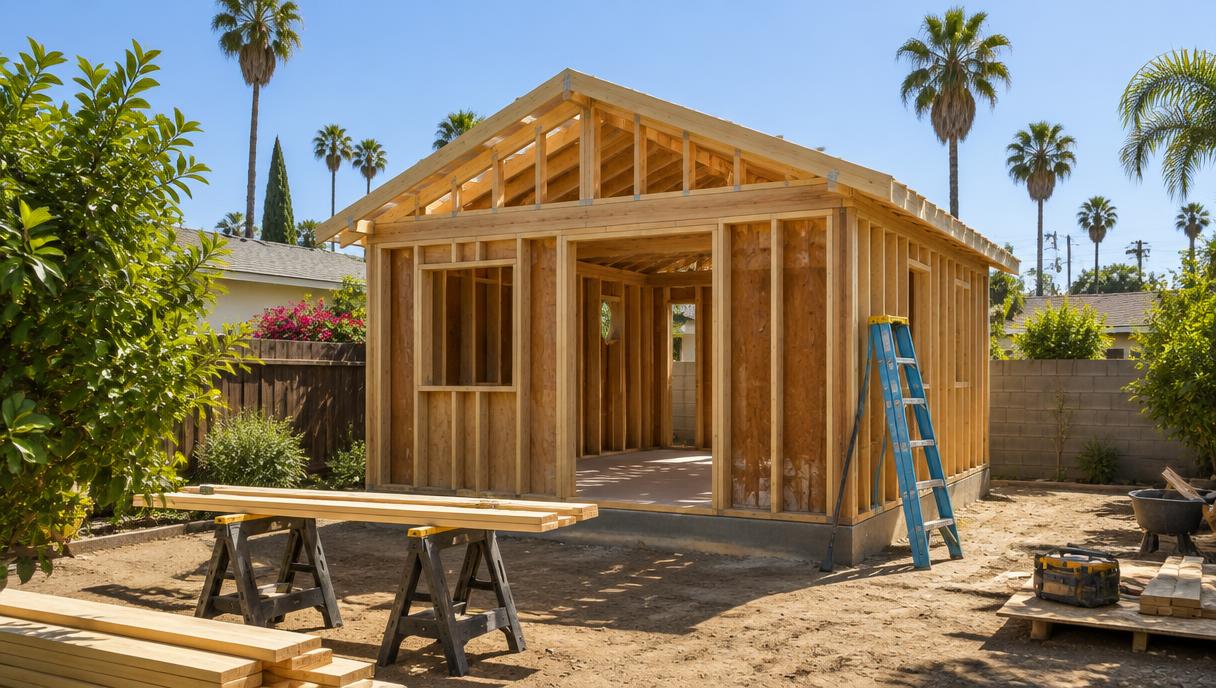
Issuance starts the second regulated phase: inspections. LADBS is explicit that work may not continue past each inspection point until the inspector approves it, and that a final inspection and approval close out the project. On a typical ADU the sequence looks like this:
- Foundation — setbacks, excavation depth and reinforcing steel are checked before concrete is poured.
- Framing and rough trades — framing, shear nailing, plumbing, electrical and mechanical rough-ins are inspected before anything is covered.
- Insulation and drywall — energy-code insulation is verified, then drywall nailing, before finishes begin.
- Final — the completed unit, smoke and carbon-monoxide alarms, safety glazing and fixtures are approved, and the permit is finaled.
Failed inspections are normal and recoverable — the inspector leaves a correction notice, the item is fixed, and it is re-inspected. What costs time is covering work before it is signed off, which can mean opening finished surfaces. Our crews schedule inspections so that never happens.
How do you keep an ADU permit moving?
Submit once, completely, with a team that draws for Los Angeles reviewers every week. Confirm clearances early. Answer corrections in days, not weeks. And treat the permit as the beginning of the schedule, not the end of it — the phase-by-phase ADU build timeline picks up where this guide stops. For the budget side, our ADU cost guide and 2026 ADU construction guide cover what drives the price.
What does a complete ADU submittal include?
Since the state clock only runs on complete applications, completeness is worth defining. A permit-ready ADU set for LADBS typically includes architectural drawings — floor plans, elevations, sections and a site plan showing the lot, setbacks, easements and utility routing — along with structural calculations, Title 24 energy documentation and any agency clearances the lot requires. On hillside or fire-zone parcels, the set grows: grading plans, geotechnical reports and fire-hazard construction details join the package. Each missing piece is a potential return-to-sender before the 60 days ever begin.
It is also worth knowing what "expedited" means at LADBS: for an additional fee on top of the plan check fee, a regular plan check review can be moved up in the queue. Expedition speeds the city’s half of the cycle; it cannot speed up corrections on your half. The projects that permit fastest combine both — a complete set, prompt responses and, when the schedule matters, an expedited review.
American Reliable Construction & Remodeling designs, permits and builds ADUs across Los Angeles County from our Sherman Oaks office. One project coordinator runs the entire permit and inspection process under CSLB #1155602. Warranty available. Call for details.
Sources
- California HCD — Accessory Dwelling Units
- LADBS — Regular Plan Check
- LADBS — Express Permits
- LADBS — Inspections
Start with a free ADU feasibility visit
If you are weighing more connected living space against an independent unit, our guide to choosing a room addition contractor in Los Angeles explains feasibility, engineering, permits and what an itemized addition or ADU comparison should include.
"Request a free estimate or call (877) 702-6180 to talk through the permit path for your lot."