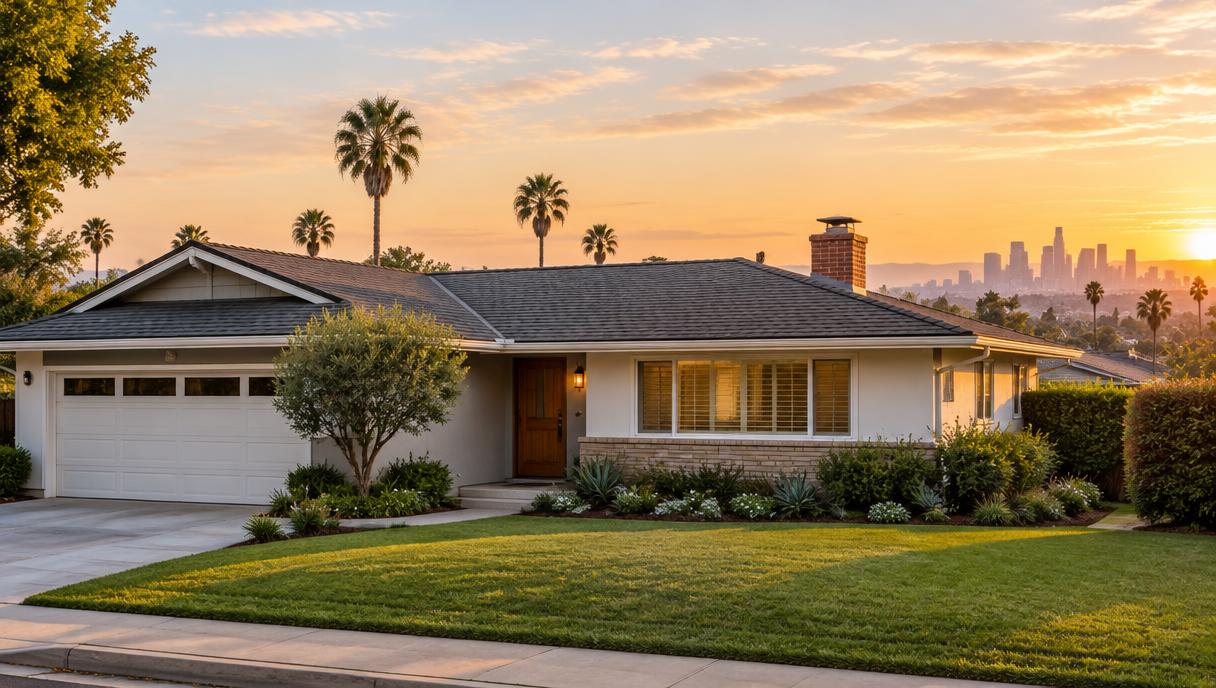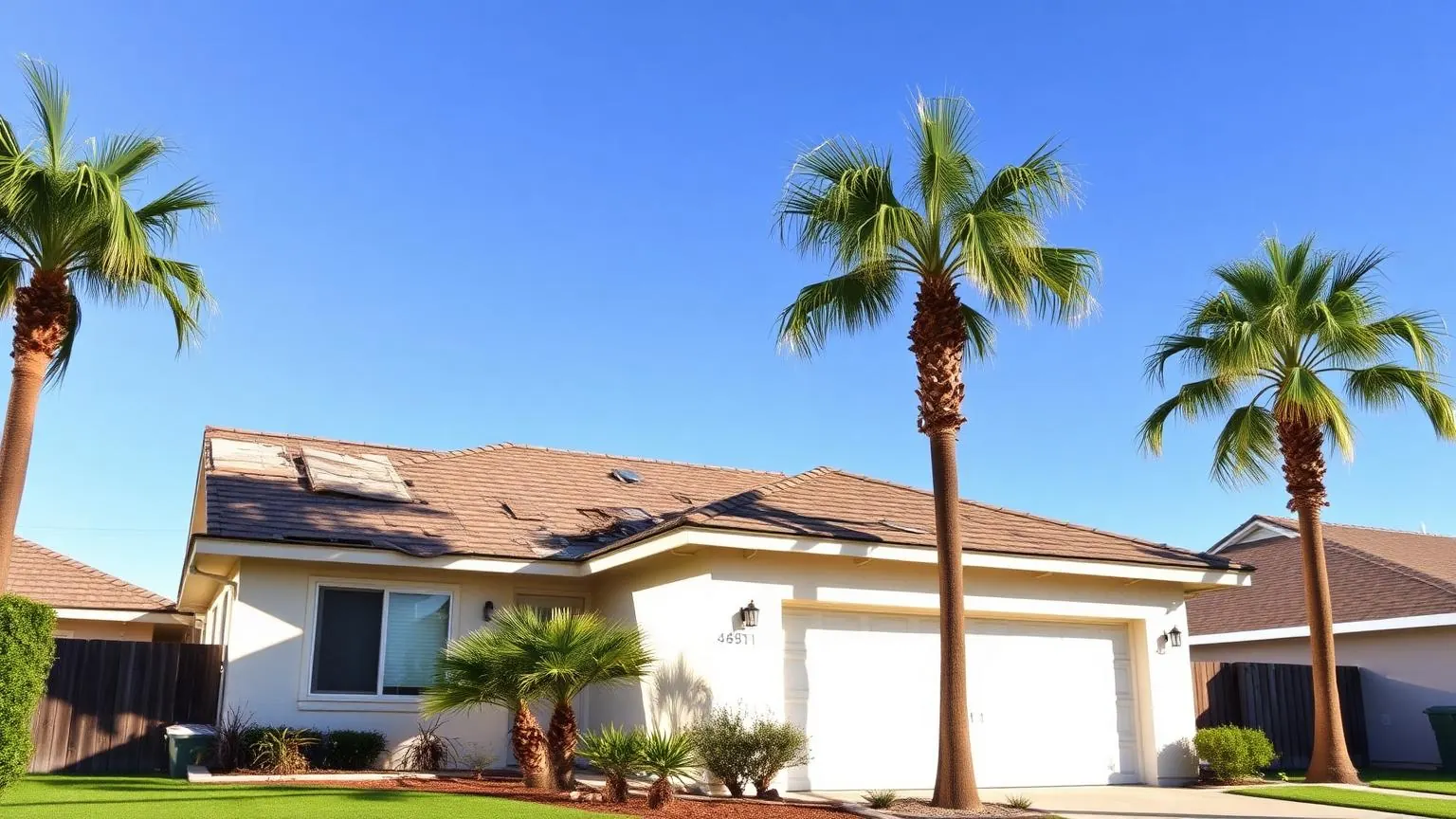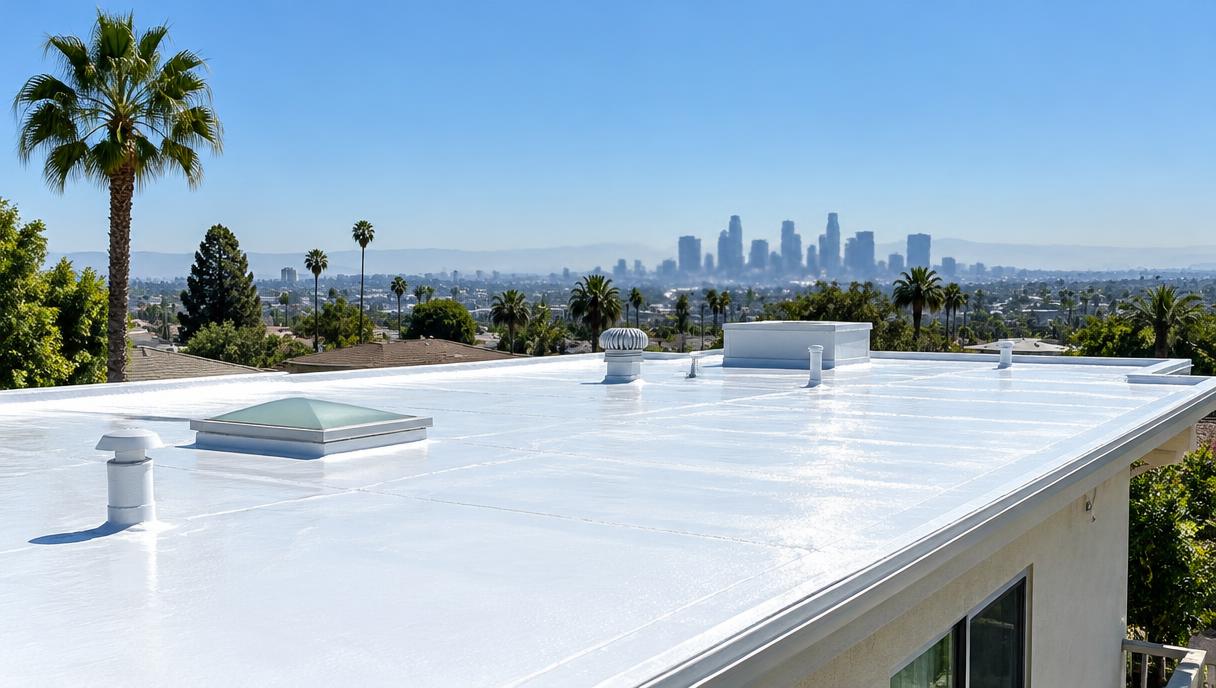
If you replace a roof in Los Angeles, you will hear the phrase "Title 24 cool roof" at the permit counter. It is not a product and not an optional upgrade — it is part of California’s Building Energy Efficiency Standards, and it decides which roofing products can legally go on your home. This guide explains what the 2022 standards require for residential re-roofs, in plain language, with the values cited to the California Energy Commission and the Cool Roof Rating Council (CRRC).
What is Title 24, and what is a cool roof?
Title 24, Part 6 is California’s energy code. Among many other things, it limits how much heat a roof may absorb, because a hot roof heats the attic, the attic heats the house, and the air conditioner pays for all of it. A "cool roof" is simply a roofing product tested and rated for two properties: solar reflectance — how much sunlight it bounces away — and thermal emittance — how readily it sheds the heat it does absorb. The two combine into a single number called the Solar Reflectance Index, or SRI.
Ratings are not self-declared. Products used for compliance must be rated by the CRRC and carry a label listing the tested values, so an inspector can verify the box, not just the brochure.
When does a re-roof trigger the requirement?
The residential re-roof provisions apply when more than half of the roof is being replaced. A patch, a repair, or replacing one slope of a large roof generally does not trigger them; a full tear-off and replacement does. Local building departments publish their own handouts on the trigger — the City of Menifee’s reroofing handout, for example, states it as "more than 50% of a roof being replaced" — and because details vary by scope, we confirm the application of the rule with the building department on every project.
What does Title 24 require for low-slope roofs?
Low-slope means a pitch of 2:12 or less — the flat and near-flat roofs common on mid-century homes across the Valley. For single-family re-roofs in the climate zones where the rule applies, the prescriptive minimums are an aged solar reflectance of 0.63, a thermal emittance of 0.75, or an SRI of 75. In practice that points to white single-ply membranes such as TPO, reflective coatings, or rated cap sheets — which is why the flat roofs of Los Angeles have been getting whiter for a decade.
What does Title 24 require for steep-slope roofs?
Steep-slope means a pitch greater than 2:12 — shingle and tile roofs. The prescriptive minimums are lower here: an aged solar reflectance of 0.20, thermal emittance of 0.75, or an SRI of 16. That 0.20 reflectance is the key number for homeowners who picture a cool roof as a white roof: it is met by a wide range of ordinary "cool" asphalt shingles in grays, browns and weathered tones. You keep the look of the neighborhood; the shingle granules do the work.
Which climate zones do the rules apply in?
This is where Los Angeles geography matters. Most of the city — the basin and the San Fernando Valley, including Sherman Oaks, Encino and Studio City — sits in Climate Zone 9. Coastal areas fall in Zones 6 and 8, some foothill areas in Zone 10, and the high mountain parts of the county in Zone 16. Under the 2022 standards, the residential re-roof cool-roof requirements apply to steep-slope roofs in Climate Zones 4 and 8 through 15, and to low-slope roofs in Zones 4 and 6 through 15. In other words, they cover essentially every Los Angeles homeowner reading this — Zone 9 included — while the highest mountain areas in Zone 16 sit outside the listed zones.
Because a single address can sit near a zone boundary, we confirm the climate zone for the property as part of the permit documents rather than guessing from the neighborhood name. The California Energy Commission publishes the official climate zone maps, and the enforcement question — which edition and compliance path apply to your scope — belongs to the building department that issues your permit.
What are the exceptions?
The code treats a home as equivalent to a cool roof when the roof assembly already manages heat well. For steep-slope re-roofs, the common exception paths are:
- At least R-38 ceiling insulation, or a ceiling assembly with a U-factor of 0.025 or lower.
- A qualifying radiant barrier in the attic (not installed directly above spaced sheathing).
- In certain climate zones including Zone 9, no HVAC ducts in the attic.
- R-2 or greater continuous insulation above or below the roof deck.
Two further exemptions apply to both slopes: roof area covered by building-integrated solar panels, and roof constructions weighing at least 25 lb/ft² over the membrane — a category that covers some heavy tile assemblies. For low-slope roofs, adding insulation at the roof deck per the code tables can also substitute for reflectance. The practical takeaway: an uninsulated attic and a re-roof are a natural pairing, and sometimes the insulation path is the right compliance route. We lay out the options in the estimate either way.
How does compliance show up in your project?
On a permitted re-roof, compliance is documented with CRRC-rated products and the energy forms submitted with the permit. You should expect your estimate to name the roofing product and its rated values, not just "30-year shingle." If a bid cannot tell you the reflectance of what is going on your house, that is a conversation to have before signing — and our guide to comparing contractor quotes covers the rest of that checklist. For what the rules add to the budget, see our roof replacement cost guide.
Does a cool roof change which products we install?
For most homeowners, less than you would expect. On steep-slope roofs, the major shingle manufacturers sell CRRC-rated "cool" versions of their standard architectural shingles in the same colors Los Angeles neighborhoods already wear, so compliance rarely forces a visible change. On low-slope roofs, the practical effect is bigger: white single-ply membranes and reflective coatings meet the 0.63 reflectance value comfortably, and they have become the default on Valley flat roofs for good reason — they also run cooler and last longer in our sun.
It is also worth separating what Title 24 does not do. It does not require solar panels on a re-roof, it does not dictate color on steep-slope homes, and it does not apply to repairs — only to replacements past the half-roof trigger. Homeowners sometimes delay a needed re-roof out of worry that the energy code will force a redesign; in practice, compliance is usually a product-selection checkbox your roofer handles inside the permit.
Where product choice does get interesting is the exception paths. A homeowner set on a non-rated designer shingle can sometimes comply through the insulation or radiant-barrier routes instead, and that trade — the roof you want plus added attic work, versus a rated shingle with no added scope — is exactly the kind of decision we price both ways in the estimate. The code offers paths; the right one depends on your attic, your budget and the look you are after.
American Reliable Construction & Remodeling replaces roofs across Los Angeles County under CSLB #1155602, with Title 24 documentation included on every permitted re-roof. Warranty available. Call for details.
Sources
- California Energy Commission — 2022 Building Energy Efficiency Standards
- California Energy Commission — Energy Efficient Cool Roofs, Single-Family (2022)
- Cool Roof Rating Council — 2022 Title 24 Cool Roof Requirements Summary
Schedule a free roof inspection
Before comparing roof proposals, use our guide to choosing a roofing company in Los Angeles to check licensing, the condition report, permit responsibility, materials and payment terms.
"Call (877) 702-6180 for a free, itemized roof replacement estimate."